

Development of an Artificial Intelligence model is just one component of building an effective AI system. After an AI model has been developed and tested, it has to be deployed in such a way that the user, application, or business has an easy and reliable way to access it. This is when the skills in AI deployment become necessary. Whether it is a recommendation engine, chatbot, visual recognition system, or a predictive analytics service, an AI model has to be deployed in order for it to work in a production environment.
In today’s world, companies use different software tools and cloud services to deploy their AI applications rapidly, efficiently, and effectively. Using such tools enables an organization to take a trained model from a developer’s PC and deploy it in the production environment in a consistent, scalable, and reliable way.
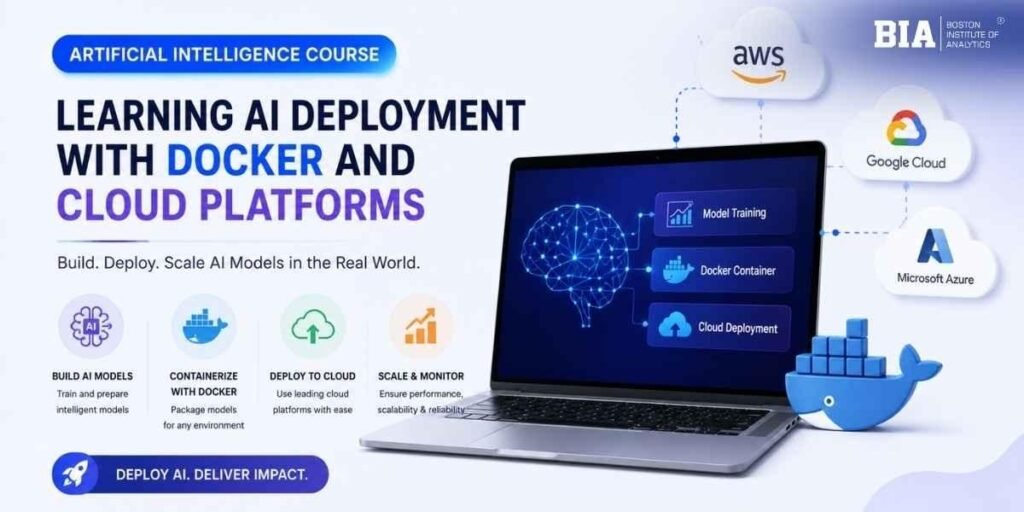
The contemporary Artificial Intelligence Course familiarizes students not only with the development process but also with AI deployment. As opposed to traditional courses that do not go beyond the training phase, this course allows one to learn how to develop end-to-end AI solutions.
Why Does an Artificial Intelligence Course Teach AI Deployment?
AI model training is just the start of an AI initiative. Companies require models which will work continuously, allow for several users, and be compatible with their websites, apps, or corporate IT systems.
In an Artificial Intelligence Course, AI deployment is discussed because that is what companies expect from specialists who are capable of deploying AI solutions. Through the course, one learns that AI deployment allows businesses to apply AI into their everyday operations safely and efficiently.
Knowledge about AI deployment is important for students because it helps them connect data science and software engineering disciplines.
1. Bridges the Gap Between Development and Real-World Use
- Helps students move AI models from development to production.
- Demonstrates how AI solutions are integrated into business applications.
- Ensures models are accessible to end users.
2. Prepares Students for Industry Requirements
- Most AI roles require deployment knowledge in addition to model development.
- Employers value candidates who understand the complete AI lifecycle.
- Builds practical skills expected in modern AI teams.
3. Improves Scalability of AI Applications
- Teaches how to deploy models that can handle thousands of users.
- Covers scaling AI services using cloud infrastructure.
- Explains load balancing and resource optimization.
4. Introduces Cloud-Based AI Services
- Familiarizes learners with cloud deployment platforms.
- Explains hosting AI applications securely online.
- Demonstrates how cloud tools simplify AI deployment.
5. Teaches Containerization and Portability
- Introduces Docker for packaging AI applications.
- Ensures consistent performance across different environments.
- Simplifies deployment across development, testing, and production systems.
6. Enables Continuous Model Updates
- Shows how to update AI models without disrupting users.
- Covers version control for machine learning models.
- Supports continuous improvement through retraining.
How Does an Artificial Intelligence Course Prepare Students for Real-World AI Projects?
The Artificial Intelligence Course ensures students are fully prepared for real-world AI tasks since it comprises both theory and practical aspects of working with artificial intelligence. In other words, students have the opportunity to practice their skills while working on industry-related cases, building machine learning models, analyzing datasets, and resolving business tasks with the help of AI methods.
In the Boston Institute of Analytics, students acquire practical experience in working with the AI tools and programming languages popular among professionals in the field. They will be familiarized with such aspects as data pre-processing, model development, deep learning, natural language processing, computer vision, and AI model deployment during projects.
Having finished an Artificial Intelligence Course, learners obtain valuable practical AI projects to include in their portfolios in order to demonstrate their competence in this area of activity. Besides, learners become ready to work in teams, manage their projects, and deploy the created AI models, which makes them ready for jobs as AI Engineers, Machine Learning Engineers, Data Scientists, and AI Developers.
Students gain experience in:
1. Builds Strong AI Fundamentals
- Teaches machine learning, deep learning, and neural network concepts.
- Develops problem-solving skills using AI techniques.
- Creates a strong foundation for advanced AI applications.
2. Provides Hands-On Project Experience
- Encourages students to build real AI applications.
- Includes practical assignments using real-world datasets.
- Strengthens technical and analytical skills through implementation.
3. Introduces Industry-Standard Tools
- Covers Python, TensorFlow, PyTorch, Docker, and cloud platforms.
- Familiarizes learners with widely used AI development frameworks.
- Prepares students for professional AI workflows.
4. Teaches Data Preparation
- Explains data collection, cleaning, and pre-processing.
- Demonstrates feature engineering techniques.
- Highlights the importance of high-quality data for AI models.
5. Develops Model Building Skills
- Guides students through training and evaluating AI models.
- Covers model optimization and performance improvement.
- Introduces techniques for selecting suitable algorithms.
This practical exposure prepares learners for professional AI development environments.
How Does an Artificial Intelligence Course Help Build Career-Ready Deployment Skills?
An Artificial Intelligence Course offers valuable career preparation by imparting knowledge on deploying AI models into practical use cases. The learners will know how to deploy AI models, integrate APIs, use cloud computing, use Docker containers, and how to monitor model performance, ensuring that AI models are robust enough to be used in real-world situations. Such knowledge is critical in the modern AI industry.
At the Boston Institute of Analytics, the learners get practical skills in deploying machine learning and deep learning models using state-of-the-art tools and approaches that are used in practice. They will learn how to package their AI models and deploy them in production, as well as monitor the performance of those models.
Learning how to deploy through an Artificial Intelligence Course makes students perfectly ready for their future careers in artificial intelligence, machine learning, and MLOps.
Students build practical skills including:
1. Teaches End-to-End AI Development
- Helps students understand the complete AI lifecycle from model creation to deployment.
- Connects development, testing, and production environments.
- Prepares learners to deliver practical AI solutions.
2. Provides Hands-On Deployment Experience
- Enables students to deploy AI models in real-world scenarios.
- Includes projects involving APIs, cloud platforms, and containerization.
- Builds confidence in handling production-ready applications.
3. Introduces Docker and Containerization
- Teaches how to package AI applications into portable containers.
- Ensures consistency across different deployment environments.
- Develops skills widely used in the AI industry.
4. Covers Cloud-Based AI Deployment
- Explains how AI applications are hosted on cloud platforms.
- Introduces scalable infrastructure for machine learning solutions.
- Helps students understand modern deployment workflows.
These skills progress employability across industries assuming Artificial Intelligence technologies.
(video link)
FAQs: Artificial Intelligence Course: Learning AI Deployment with Docker and Cloud Platforms
1. Why does an Artificial Intelligence Course teach AI deployment?
A course on Artificial Intelligence will train students on the deployment of AI since developing the machine learning algorithm is just a start. Organizations require an AI solution that can be deployed, controlled, and accessed in an actual environment. The training offered at Boston Institute of Analytics will provide students with the skills on how to deploy their AI models in applications, web pages, or API.
2. What is AI deployment in an Artificial Intelligence Course?
The deployment of AI is the process through which an AI model developed by the developer and tested is deployed to actual use in applications, web pages or API. A course on AI offered at Boston Institute of Analytics will train students on how to deploy AI solutions to actual use.
3. Why is Docker included in an Artificial Intelligence Course?
In an Artificial Intelligence Course, the use of Docker is taught to the students due to its ability to enable the developers to package their application along with the dependencies into containers. This is the case with the training provided at Boston Institute of Analytics.
4. How does an Artificial Intelligence Course prepare students for cloud platforms?
An AI Course helps the students to learn cloud deployment through introduction to cloud computing, scalable architectures, and deployment of AI models on the cloud. The Boston Institute of Analytics helps the learners acquire skills that will enable them to learn how cloud computing supports current AI solutions in the industry.
5. Does an Artificial Intelligence Course teach AI model deployment using APIs?
Yes, an AI Course helps the students to deploy AI models in the form of API to facilitate communication between AI models and websites, mobile applications, and business systems. The Boston Institute of Analytics equips the learners with skills needed to integrate AI models into existing applications through industrial deployment.
Final Thoughts
Artificial Intelligence has been disrupting different industries; however, it takes more than good models to make successful AI projects. Companies require experts who can learn to package, deploy, monitor, and maintain AI applications using new technological solutions like Docker and cloud platforms.
A good Artificial Intelligence Course gives students all necessary information about how to develop and deploy AI applications in order to be able to create not only models but also full-fledged projects. Understanding deployment technologies gives one necessary knowledge about containerization, cloud computing, APIs, monitoring, and deployment processes.
For those students who want to get ready for work in the AI industry, the Boston Institute of Analytics offers an Artificial Intelligence Course which will teach you everything about developing and deploying AI projects including machine learning, deep learning, generative AI, Docker, cloud deployment, and deployment-ready AI applications.