

In this age of artificial intelligence (AI), legal professionals are becoming more open to adopting AI into their workflows. But standards still need to be kept, such as having source-verified legal research AI tools.
Although we have generative AIs that can help you draft a research memo in seconds, fabricated citations can land you in contempt and in other penalties before the courts and regulators. So, what we’re looking for is AI answers that ideally cite real statutes, laws, cases, decisions, and judgments.
Now, if you want speed with less exposure in your legal research workflow, it’s time to look into this innovation called CaseChat AI. Read on to learn how this brings that sought-after workflow inside an Australian legal database and more.
What is CaseChat AI?
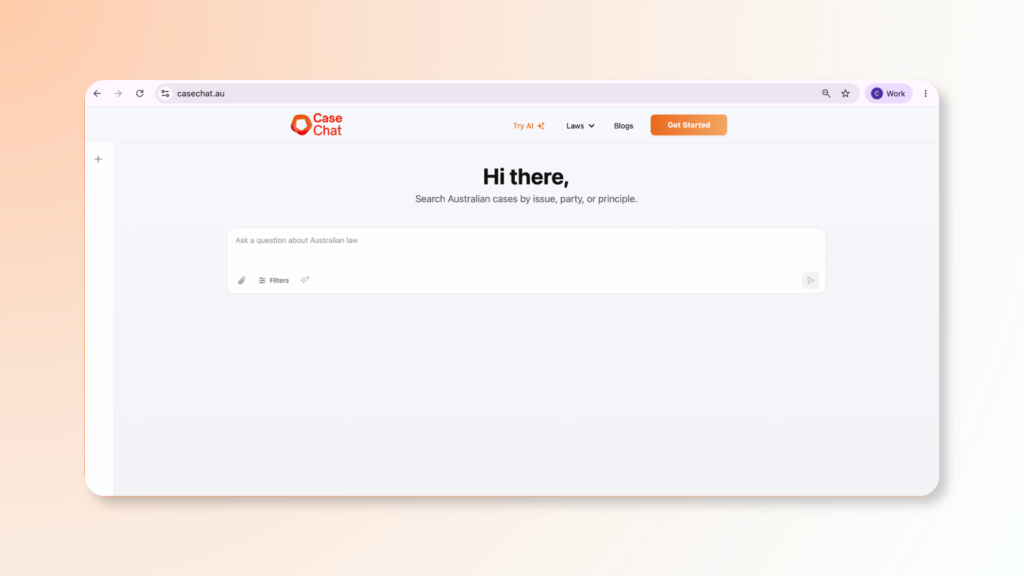
CaseChat AI is a legal research assistant built into CaseChat AU, an Australian legal research platform. It combines natural language questions with a unified Australian (AU), United Kingdom (UK) and New Zealand (NZ) case and legislation database.
As a result, every AI answer can be traced back to its source, and legal professionals can research more quickly while maintaining full control over cross-referencing and verification. It lets practitioners ask legal questions and produce answers grounded in real authorities with links to cases and statutes from the unified database.
At a glance, CaseChat AI’s core capabilities include:
- Comprehension of natural-language questions
- Multi-turn follow-ups
- Retrieval of relevant cases and legislation
- Filtering by jurisdiction from AU, UK or NZ, state or court levels
- Uploading of documents for AI analysis
- Citations that link straight to the grounded cases and legislation
The importance of source verification in the legal profession
Many of our early experiences with AI involve generative AI. These are the usual general-purpose chatbots that generate text or answers by predicting likely words.
They do not consult a specific library or database for the question, which makes them prone to hallucinations or to citations that appear real but do not exist.
In Australia, solicitors owe the court a duty of candour. Hence, negligent use of AI, such as submitting an unverified AI citation to authorities and the court, can put that duty directly in issue.
For instance, in Handa & Mallick [2024] FedCFamC2F 957, a solicitor submitted a list of authorities that the judge could not locate. He later explained that the list came from an AI tool integrated with the practice management software and that he had not verified the sources. He was ordered to show cause why his conduct should not be referred to the board.
To prevent these instances, the Supreme Court of New South Wales issued Practice Note SC Gen 23 on 21 November 2024. This required all legal practitioners to verify AI-generated citations. On the other hand, guided by this, CaseChat AI has the following features.
| Feature | Generic AI chatbot | CaseChat AI |
| Source of answers | Model training data | Retrieved cases and legislation |
| Citations | May be fabricated | Linked to the underlying document |
| Jurisdiction control | None | Filter by state or court level |
| Verification | Manual search elsewhere | Open the cited source directly |
| Own documents | Varies | Upload and query alongside case law |
How the legal research workflow works
Generally, CaseChat AI follows a workflow similar to that of any legal researcher. The only difference is that the AI assistant now handles the search and first-pass reading of all available sources in the database. At the same time, the lawyer remains responsible for discernment, judgment, and verification.
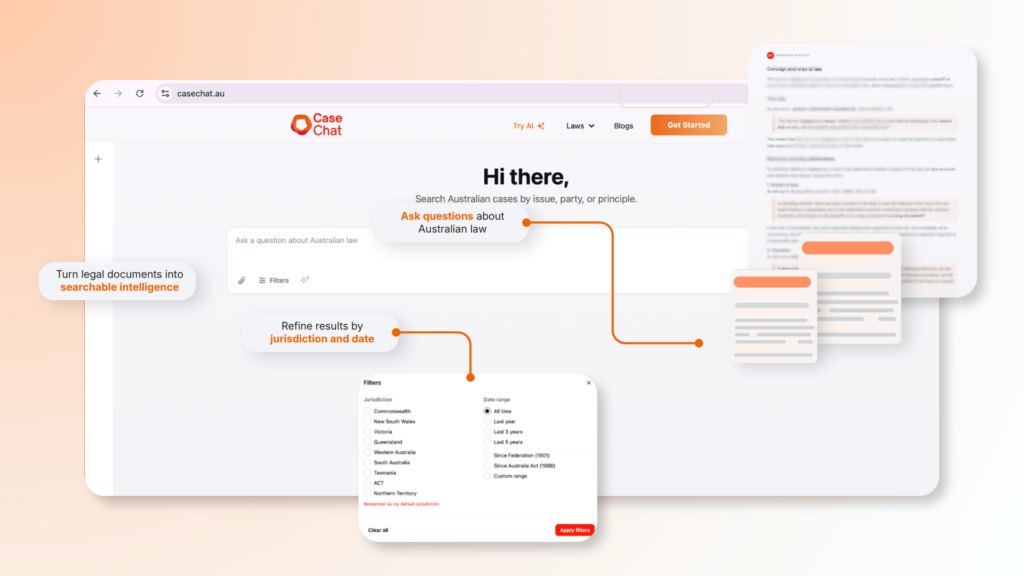
Here are the stages of how a typical question moves from prompt to verified answer:
- Asking questions in natural language: Instead of typing keywords or building a Boolean search, the user can just type a question as if they are asking a colleague, such as, ‘What are the rules on data privacy in New South Wales?’ One can also ask follow-up questions to maintain context and narrow down the answer the user is looking for.
- Surfacing relevant authorities: The AI now uses retrieval-augmented generation (RAG) by searching the case law and legislation database. From this, it crafts an answer using the retrieved materials. There are also filters for each state and court to keep all answers relevant to the correct jurisdiction.
- Checking AI answers against citations: Every answer or proposition can be traced to a specific case law or legislation. Through the clickable AGLC4 citations, one can click on the source, read the full text of the document and confirm the AI’s reasoning in context. In the end, it is the lawyer, not the AI tool, who confirms the authorities’ existence and the claims made.
On wider coverage
Another feature that sets CaseChat AI apart is that Australian legal practice regularly draws on persuasive authority from comparable common law jurisdictions such as the UK and NZ. That’s why it brings AU, UK and NZ materials into one whole legal database and collection.
Now, you won’t have to move through different websites and databases for each country while doing research. For instance, researchers can browse for UK cases on principles that Australian courts can consider. On the other hand, NZ cases are available where trans-Tasman reasoning is needed to build an argument.
| Jurisdiction | Typical research use | Browse |
| Australia | Binding and persuasive authority, legislation | Australian cases |
| United Kingdom | Persuasive authority, e.g. Donoghue v Stevenson [1932] AC 562 | UK cases |
| New Zealand | Persuasive authority on shared common law principles | NZ cases |
On document upload and judgment analysis
A lot of times, a lawyer may hold a contract, affidavit, submissions or a lengthy judgment for close reading. CaseChat AI offers an upload feature, allowing users to ask questions about uploaded documents and access its multi-jurisdictional database.
A legal researcher can upload a 100-page judgment and ask for a case note on it. It can further look for authorities dealing with the same principle as cited in the document at hand. Still, these sensitive and important documents are handled with the utmost client confidentiality and in accordance with obligations.
Who it’s built for
The launch of CaseChat AI targets lawyers and legal professionals who want AI assistance without giving up control over the accuracy of its outputs.
| User | Main benefit |
| Sole practitioners | Fast research without a library team |
| Mid-size and large firms | Quicker first drafts of research memos |
| In-house counsel | Plain-English answers across several jurisdictions |
| Law students and graduates | Clear links between answers and authorities |
Put every AI answer to the test
Now that CaseChat AI is here, legal practitioners can move faster while keeping the checks that their oath and profession demand. It brings natural-language research and source verification together one comprehensive AU, UK and NZ case and legislation database.
So, start exploring its collections of case law and legislation, and/or subscribe to CaseChat AU to research with confidence today!